Klondike is the classic solitaire card game. This guide explains how to play Klondike Solitaire online: how the cards are laid out, where each card can go, the difference between Turn 1 and Turn 3, and a worked opening from a real deal.
A ManyPlay browser walkthrough · Checked . Screenshots below show the actual game. Illustrated catalog covers are presentation artwork. Who publishes these games?
Worked example from a real deal
Start here
Click the stock in the top-left corner to turn over cards. In Turn 3 you see three cards, but only the top one can be played. Not sure whether the deal can still be won? Check deal searches for a winning continuation from the current position.
The rules you need
Build four foundations, one per suit, from Ace up to King.
On the table, build down in alternating colours. Only a King can fill an empty column.
Only the top card of the waste pile can be played, in Turn 1 and in Turn 3.
Undo takes back a move, Hint suggests one, and Check deal tells you whether a win is still possible.
Worked example: an opening Ace, Undo and Turn 3
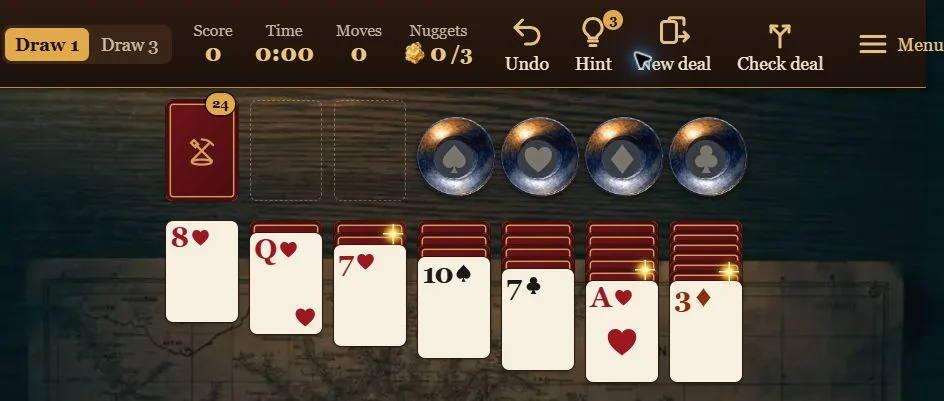
This is a real Turn 1 deal at the start: 24 cards in the stock, Score 0, Moves 0. An Ace of hearts is face up at the bottom of the sixth column — a free move to the foundations.
A real Turn 1 deal before the first move: stock 24, Score 0, Moves 0.
Move the Ace to the foundation
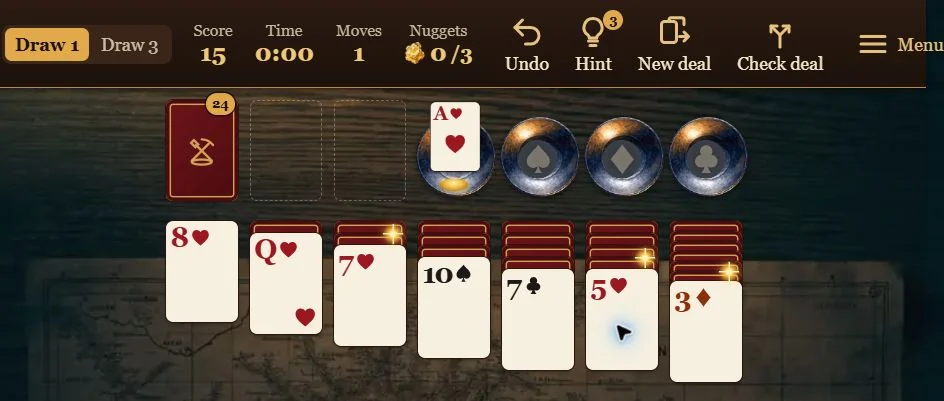
Click the Ace. It moves to its foundation and the card under it turns face up. The counters show Score 15 and Moves 1.
Move the Ace to the foundation — actual result
Undo the move
Undo puts the Ace back and restores Score 0 and Moves 0; only the timer keeps running. Undo is a handy way to compare two moves.
Use Hint and Check deal
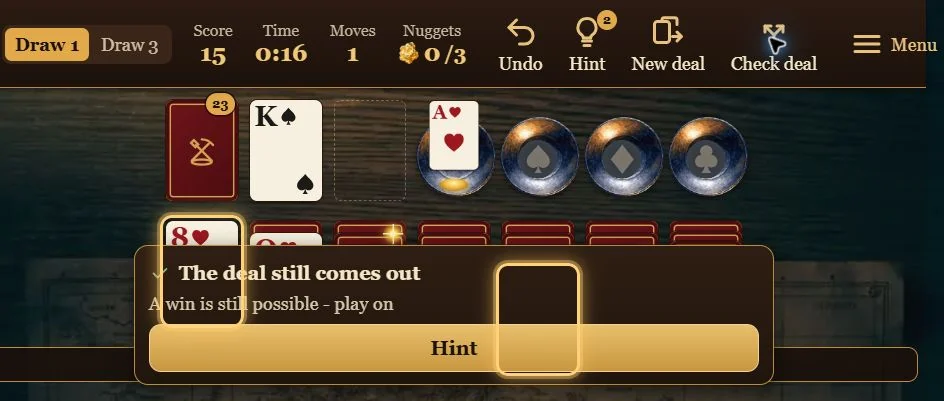
Hint suggests a move and uses one of your three free hints. Check deal answers a different question: can this deal still be won from here? After a stock draw, it reported that a win was still possible.
Use Hint and Check deal — actual result
Switch to Turn 3
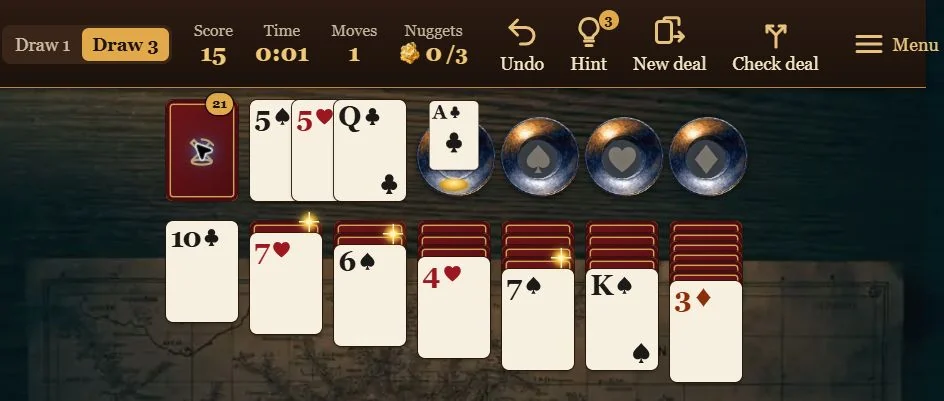
Choosing Turn 3 starts a new deal after a confirmation. One click on the stock turns over three cards — the stock drops from 24 to 21 — and only the top waste card can be played. Reload the page and the deal, score and moves are kept.
Switch to Turn 3 — actual result
What this example teaches
Moving an Ace is almost always right: it frees a card and costs nothing. Most other moves need more thought — ask which face-down card the move turns over, and whether you will need that column for a King later. Undo and Check deal let you test an idea before you commit to it.
Mistakes to avoid
Turn over face-down cards first — they hide the cards you need.
Keep an empty column for a King that can use it, rather than filling it with the first card available.
In Turn 3, look at the top waste card before drawing again.
An inconclusive Check deal does not mean the deal is lost.
Klondike Solitaire rules: common questions
How do you play Klondike Solitaire?
Move all 52 cards to the four foundations, one per suit, from Ace up to King. On the seven columns, build down in alternating colours — a red 7 on a black 8 — and turn over the face-down cards as you free them.
How are the cards laid out?
Seven columns hold 1 to 7 cards, with only the top card of each face up. The other 24 cards form the stock in the top-left corner. The four foundations start empty.
What can go in an empty column?
Only a King, or a run that starts with a King.
What is the waste pile?
Cards you turn over from the stock go to the waste pile. Only its top card can be played.
What is the difference between Turn 1 and Turn 3?
Turn 1 turns over one stock card at a time. Turn 3 turns over three, and only the top one can be played, which makes the game harder.
How do I win Klondike?
You win when all four foundations are complete, from Ace to King in each suit.
Other modes and further play
The game menu also has a daily deal, large cards and several languages. Every deal comes with three free hints.
Report a changed rule or control. Browser and Android editions can differ; the checked date describes this walkthrough, not a new game release.
UNDERSTAND THE NEXT DECISION
Rules of Klondike Solitaire in detail
Klondike combines incomplete information with choices about access. You cannot see the face-down cards, but you can inspect the exposed cards, the top waste card and the columns that your move will free. The distinction between a legal placement and a useful change is the starting point for a careful game.
The tableau and foundations have different jobs
The tableau is a working area. Build descending sequences in alternating colours, such as a red 7 on a black 8. The four foundations collect a single suit in ascending order, beginning with its Ace. A card can fit one rule while being unavailable for the other.
An empty tableau column is not a free home for every card. It accepts a King or a descending sequence beginning with a King. Before using that space, consider which hidden card the move will expose and what other King may need the column later. The rules do not make every legal choice equally helpful.
Turn 3 changes access, not the foundation rules
In Turn 3 (Draw 3), three stock cards turn onto the waste at once. Only the top waste card can be played; you cannot pick a lower card just because its rank fits. The rules for the columns and the foundations stay the same.
Because of this, the order of the stock matters more. Playing the top waste card whenever it fits uncovers the next one and keeps more cards within reach.
Undo, Hint and Check deal
Undo returns to the previous position, including the score and the move counter; the timer keeps running. Hint suggests a move and uses one of three free hints per deal.
Check deal asks whether the deal can still be won from the current position. A positive answer means a winning line exists — you still have to find it. An inconclusive answer means the search ran out of time; it does not prove the deal is lost.
Back to the fork: find where it went wrong
If Check deal finds that the deal can no longer be won, it can tell you the last move after which a win was still possible and offer Back to the fork. In one real Turn 3 game, play had reached move 48; Check deal reported that the win was lost after move 31 and took the game back to move 30. Checking again from there found a winning line.
Use the fork to rethink a decision, not to repeat it: look at the restored position and choose a different route.
Saving and switching variants
Your current deal is saved in this browser, so you can reload the page or come back later. Clearing site data or using another device starts fresh.
Switching between Turn 1 and Turn 3 starts a new deal and counts the unfinished one as played; the game asks for confirmation first.
Klondike and Spider Solitaire
Klondike uses one deck, seven columns and four Ace-to-King foundations, with alternating colours on the table. Spider Solitaire uses two decks and ten columns, and you build eight complete King-to-Ace runs in one suit.
Turn 1 and Turn 3 are Klondike settings; 1, 2 and 4 suits are Spider settings.