Spider Solitaire is a patience card game played with two decks. This guide explains how to play Spider Solitaire: the layout, the rules for moving cards and runs, dealing from the stock, scoring, and a worked first move from a real deal.
A ManyPlay browser walkthrough · Checked . Screenshots below show the actual game. Illustrated catalog covers are presentation artwork. Who publishes these games?
Worked example from a real one-suit deal
Start here
In this Spider Solitaire game, when no useful move is left, deal from the stock: each deal adds one card to all ten columns, and a game has five deals. Every column must hold at least one card before you deal. Empty columns are valuable, because they accept any card or same-suit run.
The rules you need
A single card can go on any card one rank higher, whatever its suit.
A descending run moves as a group only if all its cards share one suit.
An empty column accepts any card or same-suit run.
Complete eight King-to-Ace runs in one suit to win; each one leaves the table.
Fill every empty column before dealing from the stock.
Worked example: a first move in one-suit Spider
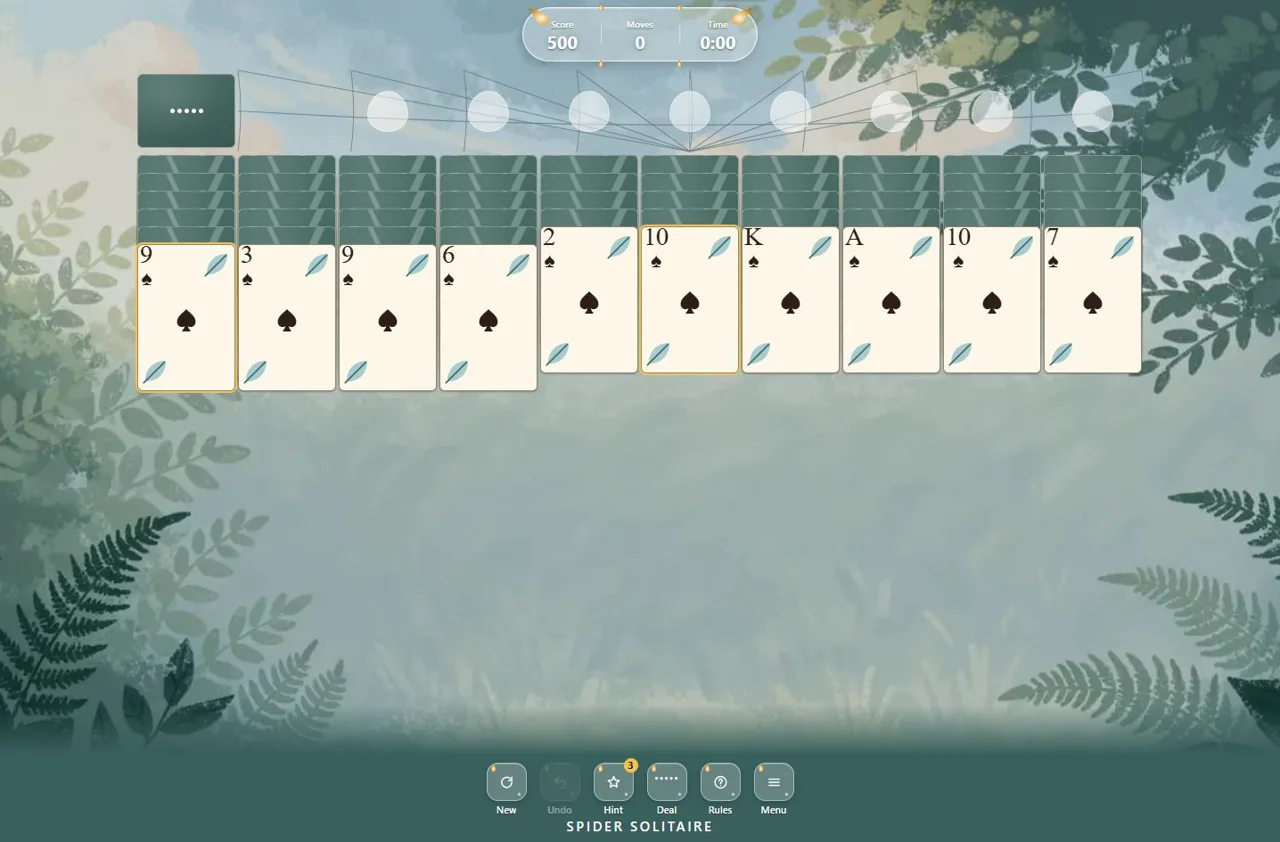
This is a real one-suit deal at the start of the game: Score 500, Moves 0. The 9 of spades at the bottom of the first column can go on the 10 of spades in the sixth column. Moving it will also turn over the card underneath.
A real one-suit deal before the first move: the 9 of spades can go on the 10.
Move the 9 onto the 10
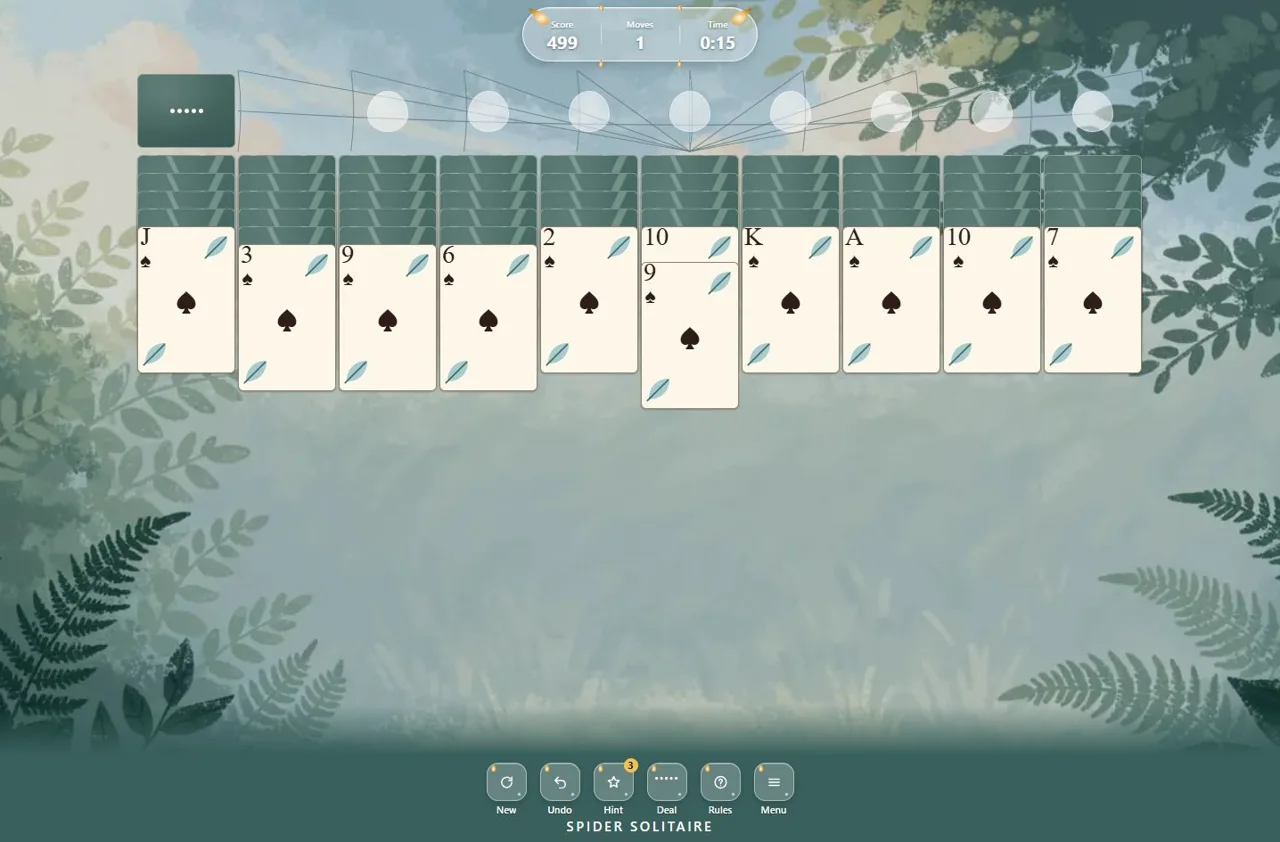
Click or tap the 9 to let the game move it, or drag it onto the 10 yourself. The 9 joins the 10 in a same-suit run, and a Jack is revealed in the first column. The counters show Score 499 and Moves 1: every move costs one point.
Move the 9 onto the 10 — actual result
Try Undo
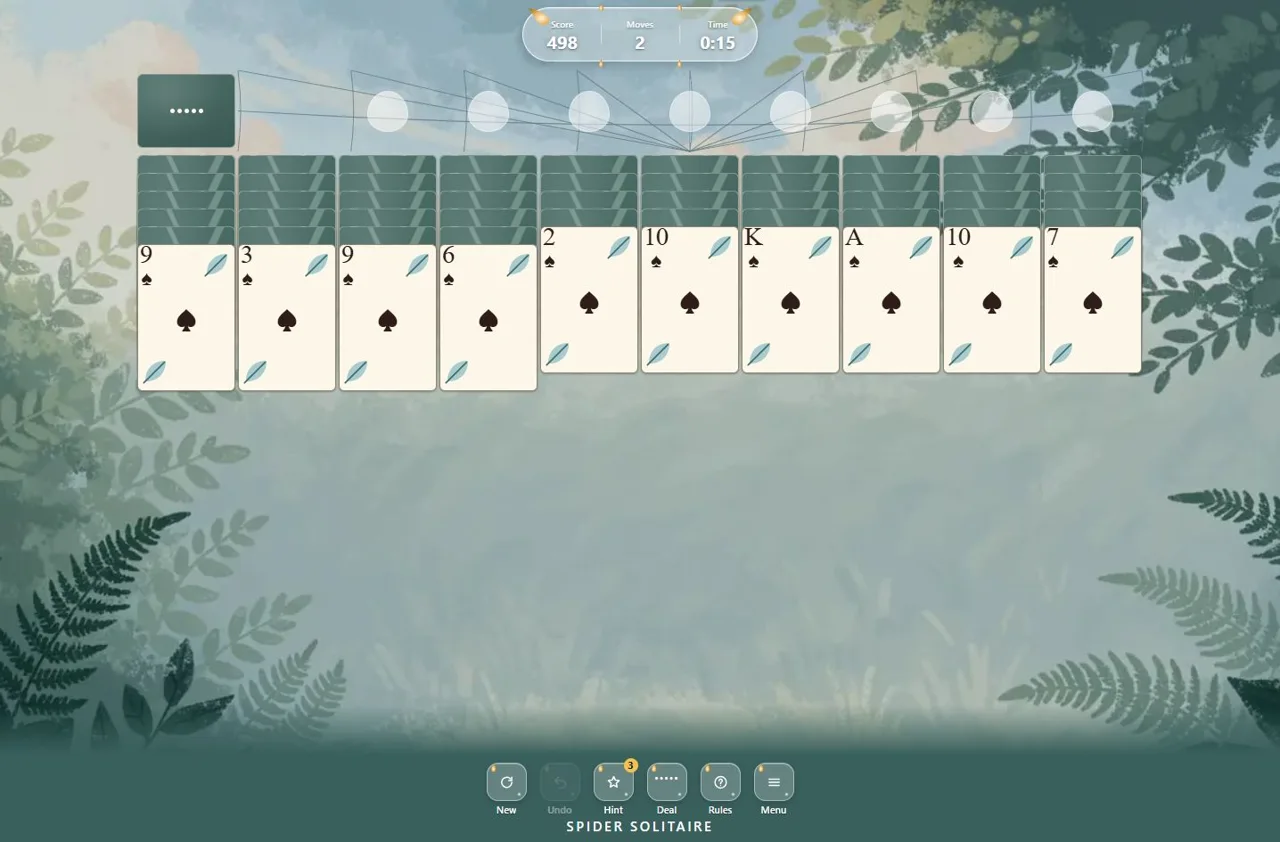
Undo puts the 9 back and covers the Jack again. The cards return to the start, but the counters now read Score 498 and Moves 2 — Undo counts as a move. Use it to compare options, not to reset the score.
Try Undo — actual result
Come back later
Reload the page and the deal, the score, the moves and the timer are all restored in the same browser.
What this example teaches
A good first move does two things at once: it builds a same-suit run and turns over a hidden card. Look for moves like that before anything else. Moves that only shuffle visible cards around rarely help.
Mistakes to avoid
Turn over hidden cards first; tidying cards that are already visible rarely helps.
Check the suits in a run before trying to move it — a mixed run will not travel together.
Keep an empty column free for as long as it is useful, then fill it before you deal.
Undo is unlimited, but each use costs one point.
Spider Solitaire rules: common questions
How do you play Spider Solitaire?
Build runs from King down to Ace in one suit. You can put any card on a card one rank higher; a run moves as a group only if all its cards share one suit. Each complete King-to-Ace run leaves the table, and you win when all eight are gone.
How are the cards dealt?
Spider uses 104 cards. 54 are dealt into ten columns — six cards in each of the first four columns and five in the other six — with only the top card face up. The other 50 stay in the stock as five deals of ten.
Can I move a run of mixed suits?
No. A run moves together only if every card in it has the same suit. You can still move its top same-suit part, or its last card, on its own.
What can go in an empty column?
Any card or same-suit run. Empty columns are the most useful space in the game, but every column must hold a card before you deal from the stock.
How does scoring work?
A game starts at 500 points. Each move costs one point, and so does each Undo.
What are the rules for dealing?
Deal adds one card to each of the ten columns. You can only deal when no column is empty, and a game has five deals.
Other modes and further play
Choose 1, 2 or 4 suits in the game menu, try the daily deal, or switch on Big cards for easier reading. Every deal comes with three free hints.
Report a changed rule or control. Browser and Android editions can differ; the checked date describes this walkthrough, not a new game release.
UNDERSTAND THE NEXT DECISION
Spider Solitaire game rules in detail
Here are the Spider Solitaire card game rules as they work in this game: the layout, moving cards and runs, empty columns, dealing from the stock and scoring.
The layout
Spider uses two decks — 104 cards. At the start, 54 cards are dealt into ten columns: six in each of the first four columns and five in each of the other six. Only the top card of each column is face up. The remaining 50 cards wait in the stock in the top-left corner, as five deals of ten.
Moving cards and runs
A single face-up card can go on any card one rank higher, whatever its suit: a 9 on any 10. A descending run can move as a group only if all of its cards are the same suit. When you move the last face-up card off a column, the card beneath it turns face up.
Empty columns
An empty column accepts any card or same-suit run, including a King. Use empty columns to sort mixed runs back into single suits and to reach hidden cards.
Dealing from the stock
Press Deal to add one card to the bottom of each of the ten columns. You can only deal when every column holds at least one card. A game has five deals.
Completing runs and winning
A complete run from King down to Ace in one suit leaves the table automatically. Clear all eight runs to win.
Score, Undo and hints
The score starts at 500. Each move costs one point, and Undo counts as a move too. Every deal comes with three free hints, and your current deal is saved in this browser.