


Word Search Tips
Every word search hides its list the same way, and a few habits find words much faster than reading the grid like a book. Here is how to play, where to look first, what changes from level to level, how to make and print your own puzzle, and what the daily puzzle is.
Play Word Search →How to play
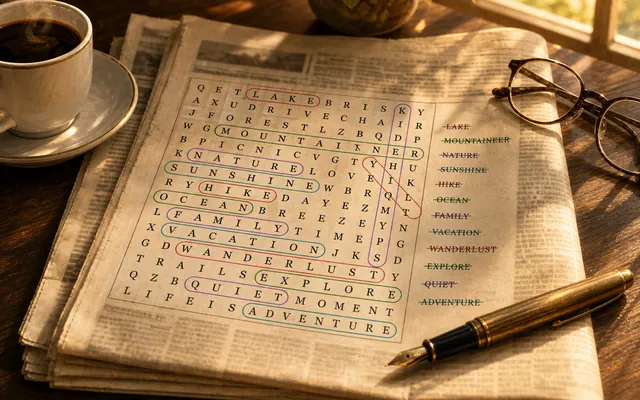
A word search is a grid of letters with a list of words beside it. All the words share a theme, such as Animals, Weather or Kitchen, and every one of them is hidden in the grid exactly once, in a straight line. The letters around them are fillers that belong to no word. Your job is to find the whole list.
To mark a word, draw a line from its first letter to its last with your finger or the mouse. If dragging is awkward, tap the first letter, then the last; on a computer you can also move with the arrow keys and press Enter at both ends. You can start from either end of a word, but the line has to cover it exactly: one letter too many and it does not count. A found word is circled in ink and struck off the list. When the whole list is crossed out, the puzzle is stamped Solved.
There is no score to chase. The top bar shows your time, which starts with your first move, and how many words of the list you have found. Your progress is saved in this browser, so you can close the page and finish the puzzle later.
Where to look
Most people read the grid like a book and hope a word jumps out. That works for the first few words, then it stalls. A plan helps.
Start with rare letters. Q, X, Z and J turn up only a handful of times in a grid. If the list has ZEBRA, SQUIRREL or FOX, find every Z, Q or X first and check the letters next to each one. It is much faster than hunting for a word that starts with E or S.
Use double letters. Pairs like EE, OO and LL catch the eye. Words such as CHEESE, BALLOON or KANGAROO often give themselves away through their doubled letters.
Check the eight neighbours. Once you spot the first letter of a word, look at the eight cells around it. If none of them holds the second letter, move on to the next copy of the first letter. If one does, follow that line to the end of the word.
Go row by row. When nothing stands out, sweep the grid one row at a time, then one column at a time. On hard puzzles read every line in both directions, because words there can run backwards.
Long words first. A long word crosses many rows or columns and is hard to miss once you have its start. Circling the long words also clears space, so the short ones are easier to see later.
Use a hint when a word refuses to appear. A hint marks only the first letter of a word, with a pencil ring. Press Hint again to move to the next word, or tap a word in the list to get the hint for that word. Hints are unlimited, and the rest of the search stays yours.
Keep an eye out for a word of the theme that is not on the list. Each puzzle except the children’s page and your own puzzles hides one bonus word, marked with a star. You do not need it to win, but it rewards a careful look.
Directions by level
The level of a puzzle decides how big the grid is and which ways the words may run.
Easy: an 8 × 10 grid with 8 words of 3 to 8 letters. Words run only across and down, read the usual way.
Medium, the default: a 10 × 13 grid with 12 words of 3 to 10 letters. Words run across, down and along both diagonals, still read from left to right and never backwards.
Hard: a 12 × 15 grid with 16 words of 4 to 12 letters. Words use all 8 directions, so they also run right to left, bottom to top and backwards along the diagonals. Many filler letters repeat the letters of the hidden words, which makes false starts common.
For kids: a 7 × 9 grid with 6 short words of 3 to 6 letters, across and down only, taken from children’s themes.
Large print: an 8 × 10 grid with 8 words, big high-contrast letters, and words across, down and diagonally down to the right.
Words on every level may cross and share a letter, so one letter can belong to two words. On medium and hard grids, a good habit is to finish all horizontal and vertical lines before turning to the diagonals.
Make your own and print it
You can build a puzzle from your own words right in the game. Open the menu and choose Make your own. Type 3 to 15 words, one per line, and add a title if you like. Pick the size, easy, medium or hard, which also sets the grid and the directions the words may take. Each word needs at least 3 letters and must fit the width of the chosen grid; the game points to any line that needs fixing. Press Create and the grid is ready in a moment.
A home-made puzzle works well for a spelling list, the names of a class, a birthday or the words of a lesson. Play it on screen straight away or print it.
Printing works for any puzzle: a theme puzzle, the daily puzzle or your own. Press Print and choose A4 or Letter. The sheet is black on white with the title, the grid and the word list; the words you have already found are not marked, so the copy is clean. Tick the answer key option to add a second page with every word circled, which is handy when you hand puzzles out to a group.
The daily puzzle
Today’s issue is a new puzzle every day, the same grid for everyone who plays with words in the same language. It is a medium puzzle, 10 × 13 with 12 words across, down and diagonally, and each day brings a different theme. It sits first in the menu.
Once you solve it, the day is marked as solved and your progress is saved in this browser. You can replay it, print it to share at the table, or start another puzzle at any level while you wait for the next issue.
Are word searches good for your brain?
A word search trains attention and vocabulary. You scan a grid line by line, hold the shape of a word in mind while you look, and meet a set of words around one theme. That is real practice in careful looking, and themed lists are a pleasant way to meet new words or to practise the words of a language you are learning.
It is a puzzle, not a treatment. Play it because it is a calm, satisfying way to spend a few minutes, not as medicine. If it relaxes you and keeps you reading closely, that is reason enough.
Play Word Search → · How to play and rules
These tips follow the rules of Word Search on ManyPlay: easy, medium and hard grids, kids and large print, the daily puzzle and your own words.