Start here
Follow the guided first game, or choose a regular pattern, card count and speed and press Play.
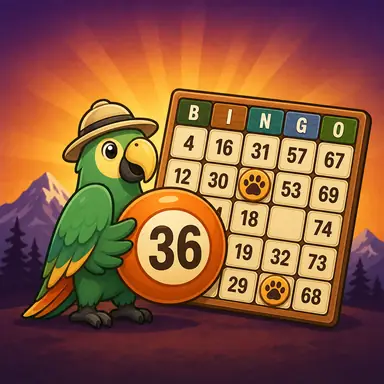 NewZoongo: Animal Bingo
 NewBackgammon
 NewWord Burrow
 NewPurr Pieces
 NewTic Tac Toe
 NewHangman
 NewMahjong Connect
 NewLudo
 New3D Snake
 NewBubble Shooter
 NewBlock Puzzle
 NewCrossword
 NewWord Search
 New2048
 NewFreeCell
 NewChess
 NewMinesweeper
 NewMahjong
 Sudoku
 Dead Moon Relay
Read the controls, follow the real example and compare the result before trying your own run.
Play Zoongo: Animal Bingo →A ManyPlay browser walkthrough · Checked . Screenshots below show the actual game. The catalog image is also a real browser capture. Who publishes these games?
Example: a ready line, just before the claim
Follow the guided first game, or choose a regular pattern, card count and speed and press Play.
Any line, one card. Kiwi has just called B-11; 26, 58 and 75 in the middle row were marked on earlier calls.
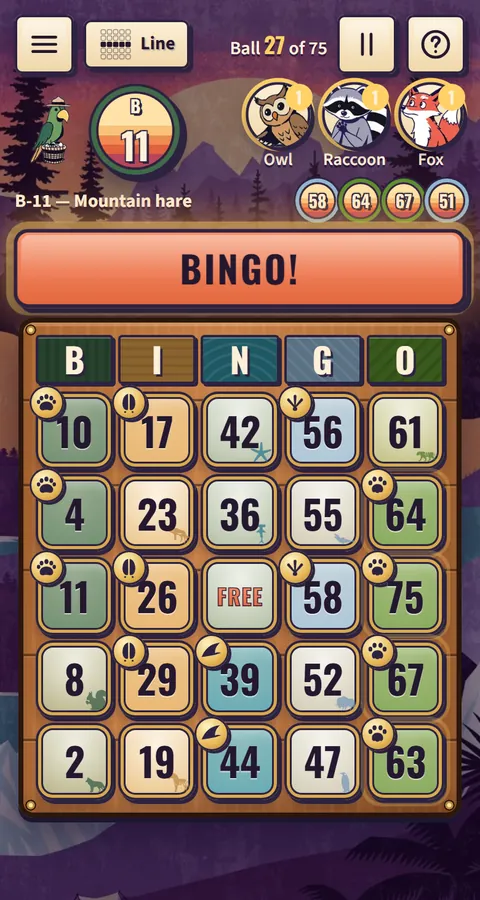
Tap 11 on the card. With 26, 58, 75 and the FREE centre it completes the middle row.
A full row meets Any line, so BINGO! glows: press it yourself. Four corners and Full card need the other patterns in the picture.
Any line accepts a row, column or diagonal on one card. A line through the FREE centre requires four numbered cells rather than five.
Read the call, find its number on your card and mark it. Complete the selected pattern on one card, then press BINGO! before Owl, Raccoon or Fox makes a valid claim.
Complete Any line, Four corners or Full card, as chosen before the round, and make the first valid BINGO! claim. Called numbers must be marked; a complete pattern does not claim itself.
The FREE centre is already marked. It counts toward any pattern that includes it, so a line through the centre needs four numbered cells.
A Zoongo card has 24 numbers and one FREE centre in a 5×5 grid. The caller draws from 75 balls, each called only once.
Yes. Zoongo is free in your browser, with no ads and no sign-up. There is nothing to buy and nothing to bet; progress is ranks, records and statistics.
Yes. Play in your browser on a phone or computer, using touch, mouse or keyboard. No sign-up is required.
No. Auto-mark stamps called numbers on your cards, but you must press BINGO! yourself. The setting is off by default.
This release uses 75 balls and a 5×5 card with a FREE centre. It does not include a 90-ball mode.
Shown on a real card in the game. Calls and cards change every round, and the round goes to the first valid claim.
Report a changed rule or control The date describes this walkthrough, not a new game release.
Learn how to play bingo: read a 75-ball card, mark called numbers, recognise three patterns and claim BINGO! in Zoongo.
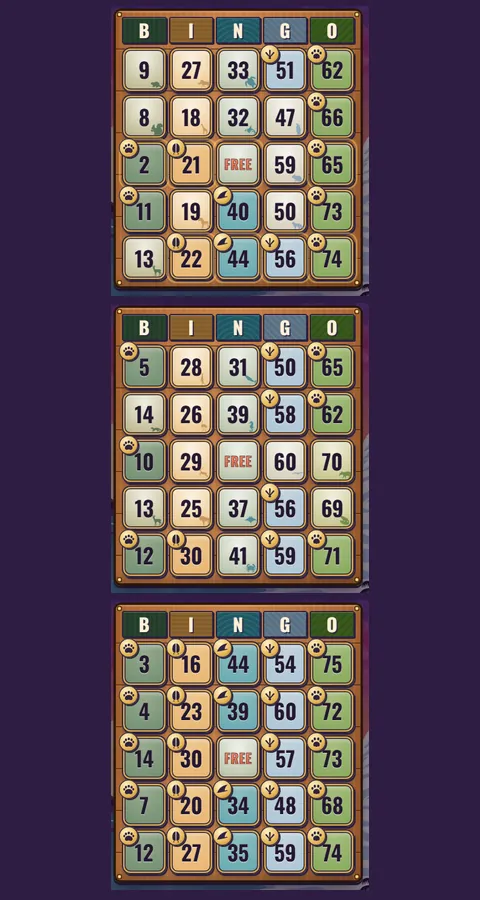
A Zoongo card has five columns headed B, I, N, G and O. Their number ranges are B 1–15, I 16–30, N 31–45, G 46–60 and O 61–75. There are 24 numbered cells and one FREE centre. The centre counts as marked from the start, so you do not need to wait for a special ball to use it.
The column letter helps you narrow the search before reading individual cells. A call in N belongs in the middle column, for example. Numbers are not arranged in ascending order within a column. Look for the actual number rather than assuming it will occupy a particular row. The animal illustration accompanies the number; the number still tells you which cell to mark.
Kiwi the parrot shows a column letter, a number and its animal for each call. Each of the 75 balls is drawn once. Tap or click a matching cell to stamp it. If the called number is absent from your card, wait for the next call. Tapping a number that has not been called does not mark it, and tapping an already marked cell does not remove its stamp.
With several cards, the same number can appear on more than one card. Mark each matching cell separately when playing manually. You can also mark a number called earlier, even after it leaves the recent-call display. The Missed hint points out called numbers left unmarked after three seconds. It helps you find a cell; it does not place the stamp for you.
Any line accepts one complete horizontal row, vertical column or diagonal. The five rows, five columns and two diagonals are all eligible. A line through the FREE centre needs four numbered cells; a line without the centre needs five. You only need one qualifying line on one card. Marks on separate cards cannot be combined to create it.
Four corners requires the top-left, top-right, bottom-left and bottom-right cells on one card. A line is not required for this pattern. Full card requires all 24 numbered cells, with the FREE centre already counted. Read the pattern selected for the round before deciding whether your marks are enough. Completing a line does not finish a Full card round.
When a card completes the selected pattern, the BINGO! button glows. Press it yourself: having the marks is not an automatic claim. Owl, Raccoon and Fox mark their own cards and make their own claims after a short delay. The round ends with the first valid claim, so noticing a completed pattern and claiming it are both part of play.
A false claim keeps the round going, shows how many marks are missing and disables the button for two seconds. Check the marks rather than repeatedly pressing it. The same rule applies when called numbers could complete a pattern but some remain unmarked. On a keyboard, B makes the claim; arrow keys move cell focus and Enter or Space marks the focused cell.
Before a round, choose one to four cards and Slow, Normal or Fast calling. Calls are spaced five seconds apart on Slow, 3.5 seconds on Normal and two seconds on Fast. The default setup is Any line, one card and Normal. Starting with one card and Slow is a practical way to practise the search-and-mark sequence before watching several cards.
Auto-mark in Settings is off by default. Turning it on stamps called numbers across your cards, including earlier calls when enabled during a round. It still leaves the BINGO! claim to you. The pattern and card count stay fixed during the round, while speed can be changed on pause. Pause also stops rival claim timers, so it gives you time to read the rules.
The guided first game introduces the card, a matching call, a call absent from your card, missed-number help, the pattern, rivals and the BINGO! claim. It is a practice game and does not count toward ranks or statistics. Use that round to learn the sequence, then choose a regular preset for results that contribute to progress.
Regular wins advance the ranks Observer, Tracker, Ranger, Warden and Reserve Keeper at totals of 0, 3, 10, 25 and 50 wins. Statistics separates results by pattern, including games, wins, win share, best result and streaks. Best means the fewest balls called before a win, rather than the shortest elapsed time. A faster caller therefore changes the pace without changing what that record measures.
This release is 75-ball bingo. Traditional 90-ball bingo uses a different 3×9 ticket with 15 numbers and no FREE centre; its stages are one line, two lines and a full house. Those rules describe another form of bingo, not an additional mode available here. In Zoongo, choose among Any line, Four corners and Full card on the five-by-five card.
For online play, the repeatable sequence is simple: read the call, find the number, mark every matching card, check the chosen pattern and claim BINGO! when ready. Use the questions below to review the FREE centre, the card size and the difference between marking and claiming. Neither the animal artwork nor Auto-mark changes the selected pattern you need to complete.
Explanation checked 2026-11-22. Checked against the game build (l10n en.json, params.js, view/play.js) and real shots of the game on 22.11.2026.