






Chess Strategies for Beginners
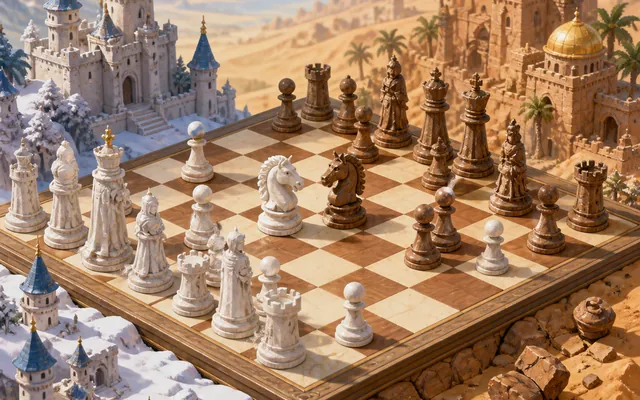
Knowing how the pieces move is only the start. Most games between beginners are decided not by deep plans but by a few simple habits. Learn these chess strategies for beginners, try them against the first rulers of the desert kingdom, and you will feel the difference within a few games.
Play Chess →1. Fight for the centre
The four squares in the middle of the board, d4, e4, d5 and e5, are the most important at the start. A piece in the centre controls more squares and can reach either side of the board quickly. Begin with a pawn move such as e4 or d4, which takes space and opens lines for your bishop and queen. If your opponent leaves the centre to you, take it; if they take it, challenge it with your own pawns and pieces.
2. Develop your pieces first
Development means bringing your knights and bishops off the back rank to squares where they work. In the first ten moves, aim to move every minor piece once. Knights usually belong on f3 and c3 (f6 and c6 for Black), where they watch the centre. Bishops go to open diagonals. A common beginner mistake is to bring the queen out early: she is easy to attack, and every time you retreat her you lose a move while your opponent develops.
3. Castle early
Your king is safest in a corner behind a wall of pawns. Castling does two jobs at once: it tucks the king away and brings a rook toward the centre, where it can join the game. Try to castle within the first ten or twelve moves. After castling, avoid pushing the pawns in front of your king without a good reason, because every pawn move there leaves a hole an enemy piece can use.
4. Do not move the same piece twice in the opening
Every move in the opening should bring something new into play. Moving one knight back and forth, or chasing an enemy piece with the same piece again and again, wastes time. While you spend moves on one piece, your opponent develops all of theirs, and soon they have more pieces working than you do.
5. Know the value of the pieces
A simple scale helps you judge every trade. A pawn is worth 1 point, a knight 3, a bishop 3, a rook 5 and the queen 9. The king is beyond value, because losing it loses the game. Before you capture, count: giving a knight for a pawn loses 2 points, while giving a rook for a knight and a pawn is nearly even. The material balance on the game's panel shows who is ahead, as plus N for the side with more points.
6. Count the exchanges before you capture
Before you take a piece, look at every attacker and defender of that square. If a square is attacked by two of your pieces and defended by one enemy piece, you can usually win material there; if it is defended twice, the trade may cost you. Start the capture with your least valuable piece. And after every move of your opponent, ask two questions: what does this move attack, and what does it leave undefended? This one habit prevents most blunders.
7. Learn the basic mates in the endgame
When most pieces are gone, you must know how to finish the game. With a queen and king against a lone king, use the queen to push the enemy king toward the edge, one rank or file at a time, staying a knight's jump away so the king is not stalemated; then bring your own king close and give mate on the edge. With a rook and king, use the rook to cut the board and your king to take away squares, and drive the enemy king to the edge in the same way. Practise these mates until they feel easy, because many won games are thrown away as a draw at the end.
Bonus: think in plans, not single moves
When there is no tactic on the board, choose a simple plan. Improve your worst piece, put rooks on open files, push a pawn where you have more pawns, or attack a weak pawn that cannot be defended by another pawn. A modest plan carried out move by move beats random moves every time.
How to practise
Play against the computer and raise the level step by step. The Dune Warden, the first ruler, forgives many mistakes; each next ruler searches deeper and lets fewer of them go unpunished. Use undo to see what would have happened after a different move, and use a hint when you are stuck to see the move the computer likes. A clean win without undo or hints is worth more glory, so when you feel ready, play without help and keep the habits above in mind.
Play Chess → · How to play and rules
Practise one habit at a time against the first rulers of the desert kingdom. These tips follow the rules of Chess on ManyPlay.