Start here
New to Snake? The snake moves on its own, one cell at a time, and you only choose where it turns. Every fruit makes it one cell longer; the run ends when the head hits a wall or the snake's own body.
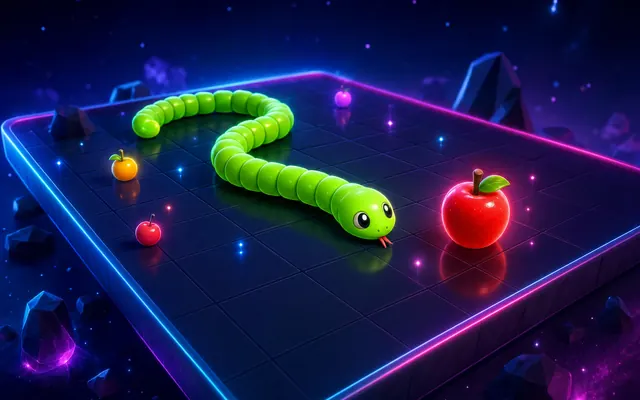 New3D Snake
 NewBubble Shooter
 NewCrossword
 NewWord Search
 New2048
 NewFreeCell
 NewChess
 NewMinesweeper
 NewMahjong
 COMET
 Dead Moon Relay
 Gridora
 Molecular
 Paper Peaks
Snake in one sentence: steer a snake that never stops, eat fruit to grow, and never hit a wall or your own body. Below is a real Classic run from the game, step by step, and then every rule in detail.
Play 3D Snake →A ManyPlay browser walkthrough · Checked . Screenshots below show the actual game. Illustrated catalog covers are presentation artwork. Who publishes these games?
Verified opening-board solution
New to Snake? The snake moves on its own, one cell at a time, and you only choose where it turns. Every fruit makes it one cell longer; the run ends when the head hits a wall or the snake's own body.
Here is a real Classic run at Slow speed, played in the game with the arrow keys: a snake of 3 cells in the middle of the 17 × 17 board, heading right, and the first fruit 7 rows up and 2 columns to the left.
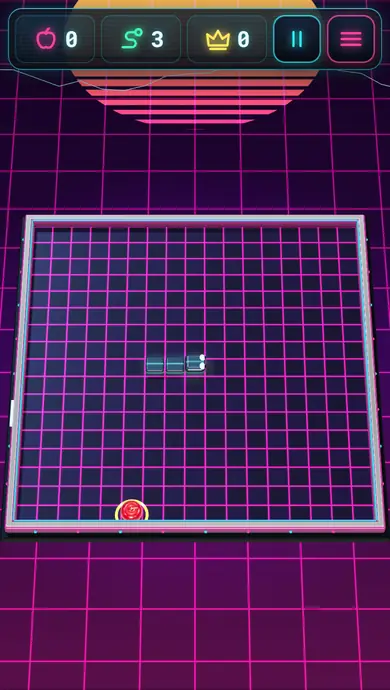
Up, then left at the fruit's row: the snake reaches the fruit by the shortest way, so the fruit is worth its 10 points plus the full 5-point bonus. The snake is now 4 cells long and the score is 15.
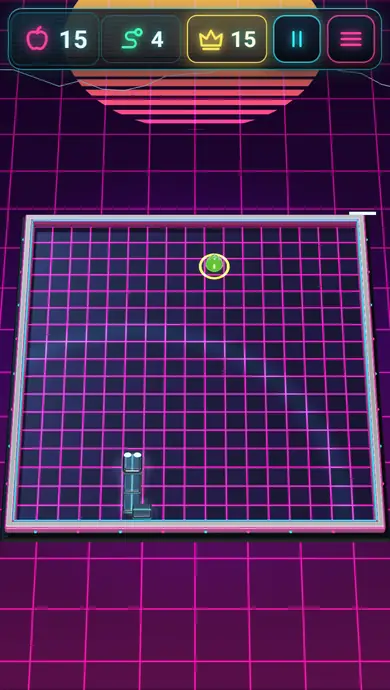
Each new fruit appears on a free cell, and each time the snake turns toward it along the shortest path that does not cross its own body. After 4 fruits it is 7 cells long and the score is 60, every fruit with its full bonus.
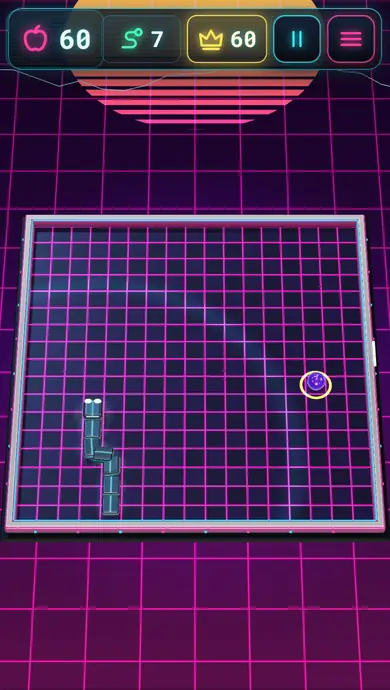
Two more fruits bring the score to 90 and the snake to 9 cells. To end the example the snake is left to run straight on, and after 86 steps the head hits the wall: the end window shows 90 points, a length of 9 and a new record for Slow.
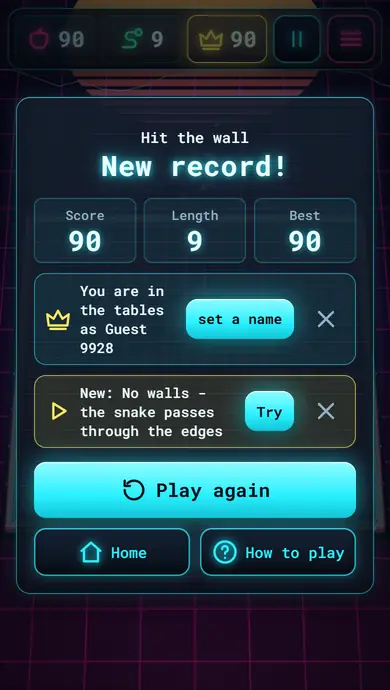
The ring around a fruit shows how much of the speed bonus is left. Turning toward each fruit at once, by a path that stays clear of the body, earned the whole bonus six times: 90 points instead of 60 for the same six fruits.
No. The speed you choose stays the same for the whole run: Slow, Normal or Fast. Faster speeds give more points for every fruit.
A snake that fills every cell of the board. There is no room left for a fruit, and the run ends with the best result the board allows.
Yes. Your best scores, skins and settings are saved in this browser, and a run left in the middle can be continued from the main screen.
The game also has No walls, two players on one screen, kids mode and the daily run, with Normal and Fast speeds. This example checks one Classic run at Slow speed in the browser build, not every mode or board.
Report a changed rule or control. Browser and Android editions can differ; the checked date describes this walkthrough, not a new game release.
Snake is one of the simplest games to learn and one of the hardest to master.
The snake never stops: it moves forward on its own, one cell at a time. You only decide where it turns.
On a phone, swipe anywhere on the screen in the direction you want the snake to go. A short, quick swipe is enough, and you can bend the snake twice in one motion - swipe up and then left without lifting your finger, and both turns are queued in order. If you prefer buttons, switch on the on-screen pad in the settings.
On a computer, use the arrow keys or W, A, S and D. Space, P or Esc pauses the run; the menu button holds the speed, the view and the other settings. The game also pauses by itself when you switch to another tab, and it counts down three seconds before the snake moves again.
The snake cannot turn straight back into its own body. If you need to go back the way you came, turn twice - for example right and then down - and the snake makes a tight U-turn.
Each run starts with a short snake of three cells in the middle of the board and one fruit somewhere on it. When the head reaches the fruit, the snake eats it, grows by one cell, and a new fruit appears on a free cell.
In Classic, the board is surrounded by walls. The run ends when the head hits a wall or any part of the snake's own body. The end window shows your score, the length of the snake and how the run ended.
If you manage to fill every cell of the board, there is no room left for another fruit and the run ends with a perfect snake - the best result the board allows.
There are three speeds: Slow, Normal and Fast. The faster the snake, the more every fruit is worth: 10 points on Slow, 20 on Normal and 30 on Fast. Each speed keeps its own best score, so a record on Slow never hides a record on Fast.
There is also a speed bonus. When a fruit appears, the game measures the shortest way to it from the head. If you take that way, you get up to half a fruit extra; a few extra steps are forgiven, and every step beyond them costs part of the bonus. The thin ring around the fruit shows how much of the bonus is still there, so you can see when a detour is no longer worth it.
Classic is the game described above: walls all around and a board of 17 by 17 cells.
No walls removes the walls. When the snake leaves one edge, it comes back on the opposite side, so the only thing that can end the run is your own body. This makes long runs easier and the late game very different: the board has no corners to hide in.
Two players puts two snakes on one larger board of 19 by 19 cells. On a computer, the first player uses W, A, S and D and the second uses the arrow keys; on a phone, each player swipes on their own half of the screen. Both snakes start after a short countdown. Hitting a wall, your own body or the other snake ends your game, and the snake that lives longer wins. If both heads meet, the round is a draw.
Kids mode is calmer: a smaller board of 13 by 13 cells, so every cell is large on a phone, and a slower snake. The walls can be switched off, so a mistake sends the snake to the other side instead of ending the run.
The daily run is the same board for everyone on the same day: the same start and the same fruit, played with the classic rules at Normal speed. You can try as many times as you like, and your best run of the day counts. Play it on consecutive days to build a streak.
Keep to the edges. In the early game, a snake that runs along the walls leaves the middle of the board open for the turns you will need later.
Fold the body in a zigzag. When the snake gets long, sweep the board in parallel rows, like mowing a lawn. The body then lies in tidy lines, and there is always a path back to the free part of the board.
Do not chase a fruit that sits next to your own tail. The fruit will still be there in a moment; a hasty turn into a narrow gap is how most long runs end.
Think two turns ahead. Before you turn into a corridor, check that there is a way out of it. A gap of one cell is a trap; a gap of two cells is a road.
Use the speed bonus only when it is safe. The shortest way to the fruit is worth extra points, but a safe route that takes a few more steps is always worth more than a crash.
Practise on No walls. Without walls you can learn how to fold a long body without the pressure of the edges, and those habits carry over to Classic.
Explanation checked 2026-11-13. Studio guide docs/page/content/en.rules.md (spec 04, git-house-morn/snake e1779b4), checked against src/game/spec.js (boards, speeds, points, the speed bonus), src/game/launch.js and the build in the browser 2026-11-13