Start here
Start with fifteen checkers: two on 24, five on 13, three on 8 and five on 6. Your home is points 1–6.
 NewBackgammon
 NewWord Burrow
 NewPurr Pieces
 NewTic Tac Toe
 NewHangman
 NewMahjong Connect
 NewLudo
 New3D Snake
 NewBubble Shooter
 NewBlock Puzzle
 NewCrossword
 NewWord Search
 New2048
 NewFreeCell
 NewChess
 NewMinesweeper
 NewMahjong
 Dead Moon Relay
 Gridora
 COMET
Bring fifteen checkers home and bear them off first. Learn the setup, separate dice moves, doubles, hitting, bar entry and scoring in the guide below. The worked examples are drawn from the rules specification; screenshots are still pending.
Play Backgammon →A ManyPlay browser walkthrough · Checked . Screenshots below show the actual game. The catalog image is also a real browser capture. Who publishes these games?
Verified opening-board solution
Start with fifteen checkers: two on 24, five on 13, three on 8 and five on 6. Your home is points 1–6.
Three independent rules examples from the supplied rules specification, not consecutive turns of one match. The opening begins at the classic starting position.
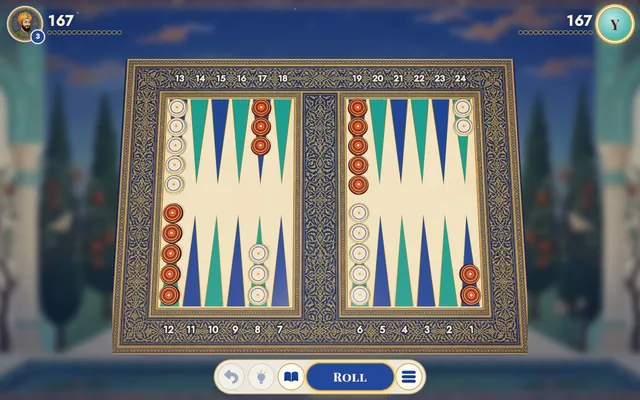
With an opening 3–1, play 8/5 6/5. Two checkers now close point 5, and your pip count drops from 167 to 163.
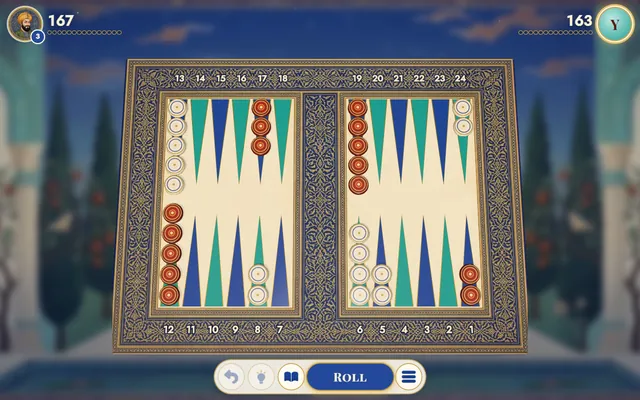
In a separate position, you have one checker on the bar and roll 4–2. If your point 21 is closed and 23 is open, use the 2 for bar/23 before moving any other checker. Use the 4 next if a legal move remains.
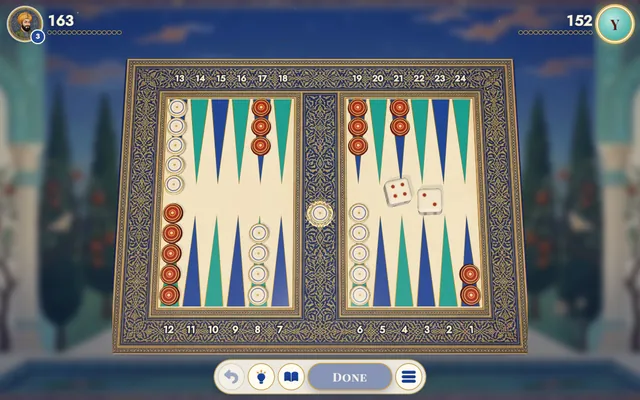
In another position, ten checkers are already off, two stand on point 4 and three on point 2. With 6–1, bear off from point 4 using the 6, then play 4/3 or 2/1 with the 1.
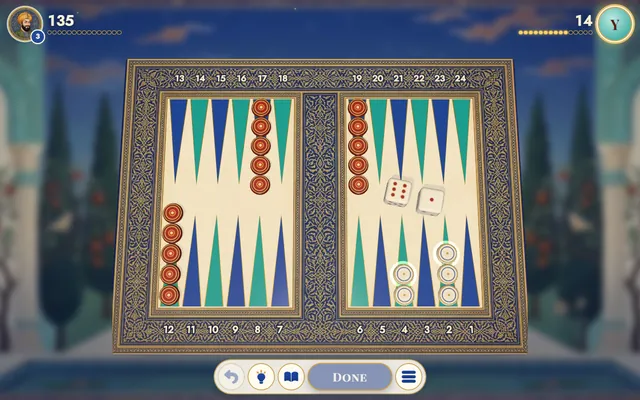
The first example creates a closed point. The second follows bar priority. The third uses an oversized die only from the highest occupied point.
Two checkers on your 24-point, five on your 13-point, three on your 8-point and five on your 6-point; your opponent mirrors you.
Towards your home board, from your 24-point down to your 1-point; your opponent moves the other way.
Yes, whenever both numbers can be played. If only one can, you play it; if either could but not both, you must play the larger.
Yes: that hits the checker and sends it to the bar.
Yes, if the die is higher than your highest occupied point: bear off from that highest point. Otherwise use the exact point or make a legal move inside home.
Yes. Your very first game is a guided game, and Play a guided game in How to play starts it again. Short steps show the dice, the moves and the controls, and each rule is explained on the board the first time it comes up.
Long Nardy has no hitting or bar and starts all fifteen checkers on the head. These worked examples use classic Backgammon; the full guide explains both rulesets.
Report a changed rule or control The date describes this walkthrough, not a new game release.
Everything you need to play your first game of backgammon, with worked examples you can try at once against a gentle computer opponent.
Classic Backgammon is a race for two players with fifteen checkers each. The board has 24 narrow triangles called points, arranged in four groups of six, with the bar in the middle. Your own point numbers run from 24 down to 1 along your route. Your home board is points 1–6. Your opponent travels the other way and numbers the board from their own side: your 24-point is their 1-point.
Bring your checkers home, then bear them off the board. The first player to bear off all fifteen wins. Point numbers describe the route, so choosing a different board view does not change the rules.
Start with two checkers on your 24-point, five on your 13-point, three on your 8-point and five on your 6-point. Your opponent mirrors this setup using their own numbers. The bar and bear-off trays begin empty. The starting pip count is 167 for each player: it is the total distance the checkers still need to travel before they are all off.
Each side rolls one die. The higher number starts and uses those two numbers for the first turn. If the numbers are equal, roll again until they differ. After the opening turn, players take turns rolling both dice. Rolls do not depend on the position or on the strength of the computer opponent.
Each die is a separate forward move. You can move two checkers by one number each, or use both numbers on the same checker in sequence. Every landing point, including the stop between the two numbers, must be open. You may jump over closed points within a single die move; the landing point is what matters.
An empty point or a point occupied by your own checkers is open. A single opposing checker is also a legal landing in classic Backgammon: you hit it. Two or more opposing checkers close the point. With an opening 3–1, 8/5 6/5 brings two checkers to point 5 and closes it.
Use both numbers whenever a legal full turn allows it, even if that requires a different order from the one you first considered. If only one number can be played, use it. If either number can be played alone but the two cannot both be played, you must use the larger number.
A double supplies four moves of the same number. Play as many of those moves as are legally possible; you do not get to stop early by choice. A 6–6 moves 24 pips only if all four sixes can actually be played. When no legal move exists, the turn passes.
A checker alone on a point is a blot. Land on an opposing blot and it goes to the bar. While any of your checkers are on the bar, you must enter them before moving other checkers. A die d enters on your point 25 minus d, in the opponent’s home board. The entry must be open.
For example, with 4–2, if your 21-point is closed and your 23-point is open, enter with the 2 as bar/23. You can then use the 4 if a legal move remains. If neither die permits an entry, the turn passes. An entry can itself hit an opposing blot.
Begin bearing off only after all your remaining checkers are in points 1–6, with none on the bar. An exact die removes a checker from its matching point. If that point is empty and a checker remains on a higher point, move within the home board. A die above your highest occupied point can bear off a checker from that highest point.
For example, suppose ten checkers are already off and the remaining five are two on point 4 and three on point 2. With 6–1, the 6 bears off from point 4 and the 1 plays 4/3 or 2/1. If a checker is hit during bearing off, enter it and bring it home before resuming.
An ordinary win scores 1 point. If the loser has borne off no checkers, the win is a gammon for 2 points. If the loser has none off and still has a checker on the bar or in the winner’s home board, it is a backgammon for 3 points. These are single games without a doubling cube. Resigning costs the points the position would award the opponent.
Long Nardy uses the same board and dice, but all fifteen checkers start on the head, your point 24, and both sides travel the same way. Any opposing checker closes a point; there is no hitting and no bar. The higher opening die wins the right to roll both dice again for the first turn.
Normally only one checker leaves the head per turn. On each side’s own first turn, 6–6, 4–4 or 3–3 may release up to two. After every move, including intermediate moves, a row of six or more occupied points is forbidden unless an opposing checker is already beyond it in that opponent’s own direction of travel. Long Nardy scores 1 for a single win or 2 for a mars when the loser has none off; it has no 3-point backgammon.
Your very first game is a guided game; to play it again, open How to play and choose Play a guided game. Short steps cover the dice, the moves and the controls, and each rule is explained on the board the first time it comes up. Tap glowing checkers, use Roll for dice and Done to confirm a turn. Tapping a checker prefers the larger legal die; tap a die to change that priority. Automatic turn confirmation also ends the chance to undo moves inside that turn, and can be disabled in Settings.
Free games offer Hint arrows and undo of a previous turn. In 2 players, a previous turn can be undone until the other player rolls. Ladder and Daily game have no hints or previous-turn undo, but moves within an unconfirmed turn can still be undone. Daily dice are shared for the same date and ruleset. Wins in Ladder games unlock opponents and earn stamps; free wins do not advance it.
Return to /backgammon/ to play free in your browser without signing up. Choose a ruleset and an opponent before starting. Niko is the gentlest opponent; Mirra, Tahir and Master Sol offer increasing strength. Use the pip count to follow the race and the guide’s examples to practise legal moves. Both classic Backgammon and Long Nardy are available in the game.
Explanation checked 2026-11-20. Input files: page-data.json (only its five lang=en pages), page-content-en.json, page-content-en-REVIEW.md, 01_rules.md, 04_page.md, game-strings-en.js and rulesets.js. Draft based on supplied specifications and strings; runtime and screenshots not verified.