Start here
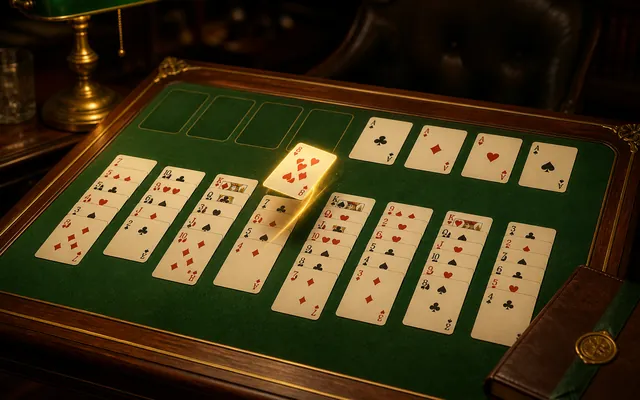
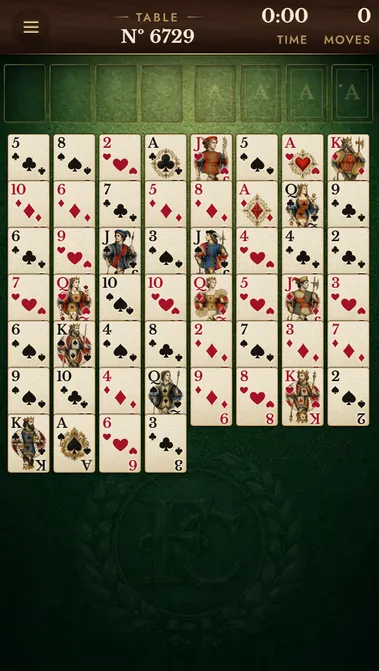
New to FreeCell? Start with a classic table. All 52 cards lie face up in 8 columns; above them are 4 free cells on the left and 4 foundations on the right. The plate at the top shows the table's number, the time and your moves.
 NewFreeCell
 NewChess
 NewMinesweeper
 NewMahjong
 Klondike Solitaire
 Spider Solitaire
 Dead Moon Relay
 Gridora
 COMET
 Molecular
 Paper Peaks
 Powderlab
 Sudoku
 Prismatic
FreeCell rules in one sentence: move all 52 face-up cards to the four foundations, from Ace to King by suit, using 4 free cells and the empty columns. Below is a real table from the game, step by step, and then every rule in detail.
Play FreeCell →A ManyPlay browser walkthrough · Checked . Screenshots below show the actual game. Illustrated catalog covers are presentation artwork. Who publishes these games?
Verified opening-board solution
New to FreeCell? Start with a classic table. All 52 cards lie face up in 8 columns; above them are 4 free cells on the left and 4 foundations on the right. The plate at the top shows the table's number, the time and your moves.
Here is the real table No. 6729 at the start. The Ace of spades lies at the bottom of column 2, free to move, and the Two of spades lies at the bottom of column 8. Column 2 has the black 10 of clubs just above its Ace, and column 5 ends with the red 9 of diamonds.
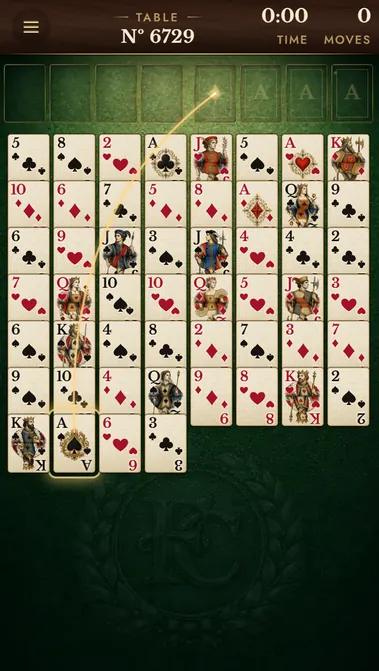
Press Hint: a golden thread runs from the Ace of spades in column 2 to the foundations. Tap the Ace and it goes home. The move counter shows 1.
Now the Two of spades at the bottom of column 8 is the next card of its suit, and the next hint lights it. Tap it and it lands on the Ace. Two moves, and the free cells are still all empty.
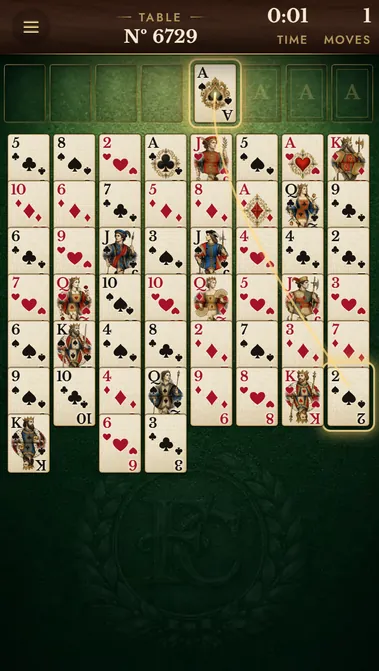
With the Ace gone, column 2 ends with the black 10 of clubs. Tap the red 9 of diamonds at the bottom of column 5: it steps onto the 10, red on black, one rank lower. Column 2 now ends with a 10–9 run, and column 5 shows the 2 of diamonds.
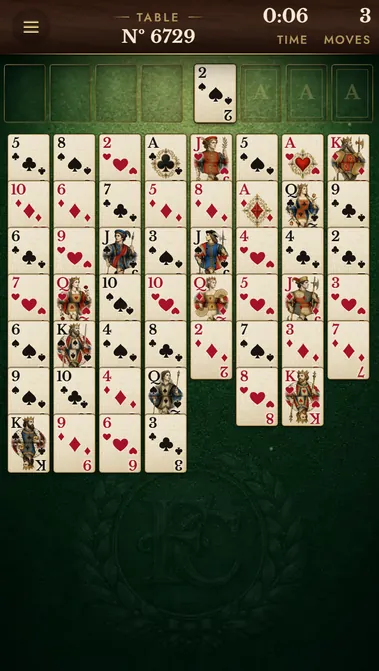
Aces and Twos at the bottom of a column cost nothing to send home, and each one opens a card under it. Building down in alternating colours in one column makes a run that can later move as a whole, while the free cells stay empty for the hard moments. That is the heart of FreeCell strategy: free the low cards, keep the cells empty and build runs where you can carry them.
Almost. Of the 32,000 classic numbered deals only one cannot be won, and this game never deals it.
One card plus one for each empty free cell, doubled for each empty column. With 4 empty free cells and no empty column that is 5 cards.
No. You send a card home with a tap or a drag. Only when every column is in order does the Finish button appear and play the rest.
The menu also has Easy deals, FreeCell Hard with 3 free cells, the daily evening table and the club book. This example checks the first moves of one classic table in the browser build, not every deal or mode.
Report a changed rule or control. Browser and Android editions can differ; the checked date describes this walkthrough, not a new game release.
FreeCell is a solitaire of pure skill: all 52 cards lie face up from the start, so nothing is hidden and almost every deal can be won. This guide walks you through the rules one step at a time.
Move all 52 cards to the four foundations. Each foundation holds one suit and is built up in order: Ace, Two, Three and so on up to King. When the last King lands on its foundation, the table is cleared and you win.
The whole deck is dealt face up into 8 columns. The first four columns get seven cards each, the last four get six. Above the columns sit two rows of four places: on the left, the 4 free cells; on the right, the 4 foundations, empty at the start. Every deal has a number from 1 to 32,000, shown on the table's plate, so the same number always gives the same cards.
Only the top card of a column — the one not covered by another card — can move. You can put it: onto the top card of another column, if that card is one rank higher and of the opposite colour (a red 6 onto a black 7, a black Queen onto a red King); into an empty free cell; into an empty column; onto its foundation, if it is the next card of that suit.
On a phone, tap a card to send it to the best place, or drag it where you want. On a computer, click or drag with the mouse; the keyboard works too. Every move can be undone, as many times as you like.
A free cell is a parking place for exactly one card of any suit and rank. Put a card there to uncover the card under it, then move it back to a column or to its foundation when it fits. Free cells are your most precious resource: a full row of cells leaves you almost no moves, so park a card only when you know how it will come back.
When you clear a column completely, it accepts any card or any ordered run. An empty column is even more valuable than a free cell, because it can hold a whole run, not just one card. Try not to drop a single card into an empty column unless it opens real progress.
An ordered run is a group of cards at the bottom of a column where each card is one rank lower than the card above it and of the opposite colour, like black 9, red 8, black 7. You may move such a run in one go, as long as you could also move it one card at a time through the empty places. The size you can carry is easy to work out: one card, plus one for each empty free cell, then doubled for each empty column. With 2 empty free cells you can move 3 cards; with 2 empty free cells and 1 empty column, 6 cards. If the run goes into an empty column, that column does not count as one of the empty columns. When a run is too long, the game tells you how many cards you can move right now.
Nothing goes to a foundation by itself — you decide when. When a card is the next of its suit, tap it and it flies to its foundation, or drag it there. Take your time: a low card you send home too early may be the one another card needed to step onto. When every column is in order, from the highest card at the top to the lowest at the bottom, the Finish button appears: press it and all the remaining cards fly home.
Start with the Aces and Twos: find where they are buried and dig toward them. Keep at least one free cell empty for as long as you can. Treat an empty column like gold: it doubles the runs you can move. Build runs in one column before you move them, and move them whole. Before you fill the last free cell, make sure the next move frees one. Stuck? Undo a few moves and try another line, or ask for a hint: it lights a useful move. Play the Easy FreeCell deals to learn, then try FreeCell Hard with three free cells.
Almost. Of the 32,000 classic numbered deals, exactly one cannot be won, and this game never deals it, so every table you get can be cleared. Some deals are harder than others, but with patience, Undo and the free cells used wisely, you can win them all. Your statistics, streaks and the card backs you earn are kept in the club book of this browser.
Explanation checked 2026-11-10. Studio rules guide docs/page/content/en/how-to-play.md (spec 04, git-house-morn/freecell 57d3cd8), checked against src/game/config.js (4 cells, 3 in Hard, 32,000 deals, deal 11982 excluded, 861 easy deals) and the build in the browser 2026-11-10