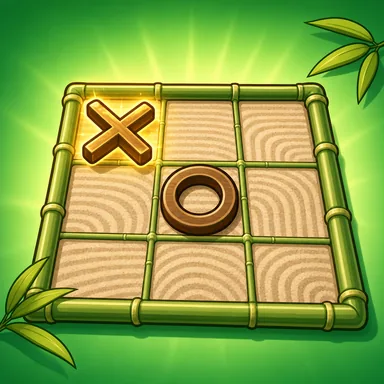














Tic Tac Toe Strategy Game
Check for a winning move, then stop the other side's immediate win. Learn how forks create two threats and how to prevent them. Against perfect play the achievable result is a draw, not a guaranteed win.
Play Tic Tac Toe →1. Win now
The most important rule of tic-tac-toe strategy is also the simplest: if you can win on this turn, you must take the win. Before considering any other move, scan the board for an opportunity to complete a line of three. This means looking for any row, column, or diagonal that already contains two of your marks and one empty cell. This check should be your first priority on every single turn. It can be tempting to play a defensive move to block an opponent's developing threat, but blocking is irrelevant if you can secure the victory right away. After you make a winning move, the game ends, and your opponent won't get another turn.
For example, imagine you are playing as X. You have marks in the top-left (cell 1) and top-middle (cell 2) cells. Your opponent, O, has marks in the bottom row (cells 7 and 8). You might feel an urge to block their potential line by playing in cell 9. However, a quick scan of your own opportunities reveals that the top row is waiting for its final X. By placing your X in the top-right cell (3), you complete the line 1-2-3 and win the game. Your opponent's threat in the bottom row becomes meaningless. Always look for your own winning move before you do anything else.
2. Block
If you have determined that you cannot win on your current turn, your very next priority is to check if your opponent can win on their next turn. If they can, you must block them. An immediate threat from your opponent takes precedence over any other strategic move you might want to make, such as setting up a future attack. Failing to block a winning move is the most common way to lose a game of tic-tac-toe. Look for any row, column, or diagonal that has two of your opponent's marks and one empty cell. You must place your mark in that empty cell to prevent their win.
Consider this scenario: you have an X in the center (cell 5) and one in the corner (cell 1). Your opponent has an O in the bottom-left (cell 7) and bottom-right (cell 9). It's your turn. You might see a good opportunity to place an X in cell 3 to set up a diagonal threat. However, you must first check your opponent's position. They have two marks in the bottom row. If you don't play in the bottom-middle cell (8), they will place their O there on the next turn and win the game. Your only correct move is to block by taking cell 8. A beautiful plan for a future attack is useless if you lose the game before you can execute it.
3. Fork
Once you've confirmed that you can't win and your opponent doesn't have an immediate winning threat to block, you can start playing more offensively. The most powerful offensive move in tic-tac-toe is the fork. A fork is a single move that creates two different winning threats simultaneously. Your opponent can only block one of these threats on their turn, which means you will be able to complete the other line and win on your next move. A real fork usually decides the game, because the opponent can close only one of the two lines.
Here is a fork from a real position. You are playing X, with marks in the top-left (cell 1) and bottom-right (cell 9) corners. Your opponent has an O in the center (cell 5) and another in the top-right corner (cell 3), so O threatens the diagonal 3-5-7 and you must take cell 7. That block is also a fork: with Xs in 1 and 7 the left column waits for cell 4, and with Xs in 7 and 9 the bottom row waits for cell 8. Your opponent can close only one of them, and you complete the other on your next move.
4. Defend
Just as you should try to create forks, you must also be vigilant about preventing your opponent from creating them. This requires thinking one or two moves ahead. If you see that your opponent is setting up a position from which they can fork you on their next turn, you need to make a defensive move to disrupt their plan. Often, this means occupying the very cell they would use to create the fork. This kind of proactive defense is the hallmark of an advanced player.
For instance, suppose your opponent (X) has marks in two opposite corners, like top-left (cell 1) and bottom-right (cell 9). You (O) have a mark in the center (cell 5). It is your turn. If you play in a corner, such as top-right (cell 3), your opponent can then play in the remaining corner (cell 7) to create a devastating fork. The correct defensive move in this situation is to play in a side cell, such as the top-middle (cell 2), bottom-middle (cell 8), left-middle (cell 4), or right-middle (cell 6). By taking a side cell, you prevent the fork from ever being formed, forcing the game to continue along a different path.
5. Position
When there are no immediate wins to take, threats to block, or forks to create or defend against, your goal should be to improve your position and control the board. Some cells are inherently more powerful than others because they are part of more potential winning lines. The general hierarchy of strategic cells is:
The Center: The center cell (5) is the most powerful. It is part of four potential winning lines (one row, one column, and two diagonals).
The Corners: The corner cells (1, 3, 7, 9) are the next best. Each is part of three potential winning lines.
The Sides: The side cells (2, 4, 6, 8) are the least powerful, as each is only part of two potential winning lines.
Therefore, if you have a free choice, taking the center is a strong opening move, though it never comes before an immediate win or a block. If the center is taken, corners are your next best bet. However, this is just a general guideline. Do not automatically take the center if a more urgent move, like blocking an opponent, is required.
6. Draw
It is important to understand that against a player who makes no mistakes, the best possible outcome is a draw. Tic-tac-toe is a "solved" game, which means that a perfect game from both sides will always result in a stalemate. Do not be discouraged if you find yourself playing to a draw against the highest-difficulty computer opponent. A series of draws is a sign of progress; it shows that you are playing accurately and not making any critical errors. The goal of learning strategy is not to find a secret that lets you win every time, but to play perfectly so that you never lose. You win when your opponent makes a mistake and you are able to capitalize on it.
7. Practice
Strategy guides are helpful, but nothing can replace hands-on practice. Playing against computer opponents of varying difficulties is an excellent way to hone your skills. The weaker opponents will make frequent mistakes, allowing you to practice recognizing opportunities to win and create forks. The strongest opponent will test your defensive skills and your ability to play a precise, error-free game. Every game, win or lose, is a learning experience. Pay attention to the moves that led to a loss and think about what you could have done differently. With enough practice, the patterns of attack and defense will become second nature.
Play Tic Tac Toe → · How to play and rules
Practise against the four opponents one by one: Lyova forgives many mistakes, Sever forgives none. These tips follow the rules of Tic Tac Toe on ManyPlay.