Start here
New to tic tac toe? The board has nine cells, numbered 1 to 9 from the top-left. You play X, the opponent plays O, and you take turns.
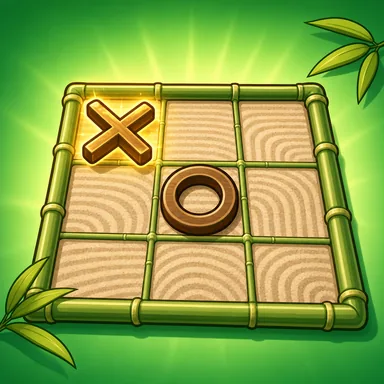 NewTic Tac Toe
 NewWord Burrow
 NewPurr Pieces
 NewHangman
 NewMahjong Connect
 NewLudo
 New3D Snake
 NewBubble Shooter
 NewBlock Puzzle
 NewCrossword
 NewWord Search
 New2048
 NewFreeCell
 NewChess
 NewMinesweeper
 NewMahjong
 Sudoku
 Dead Moon Relay
 Gridora
 COMET
How to play tic tac toe in one sentence: take turns putting X and O in the nine cells, and the first to make a line of three wins. Below is a real game from ManyPlay, step by step, and then every rule in detail.
Play Tic Tac Toe →A ManyPlay browser walkthrough · Checked . Screenshots below show the actual game. The catalog image is also a real browser capture. Who publishes these games?
Verified opening-board solution
New to tic tac toe? The board has nine cells, numbered 1 to 9 from the top-left. You play X, the opponent plays O, and you take turns.
Here is a real game from the start: a new series against Lyova, the first of the four computer opponents. You play X and move first.
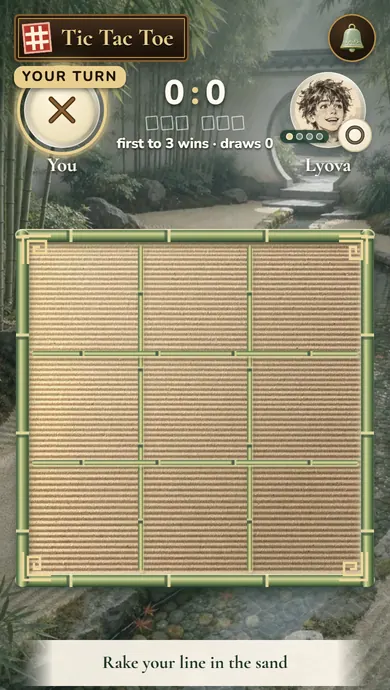
Take the centre, cell 5: it is part of four of the eight lines. Lyova answers in the corner, cell 1.
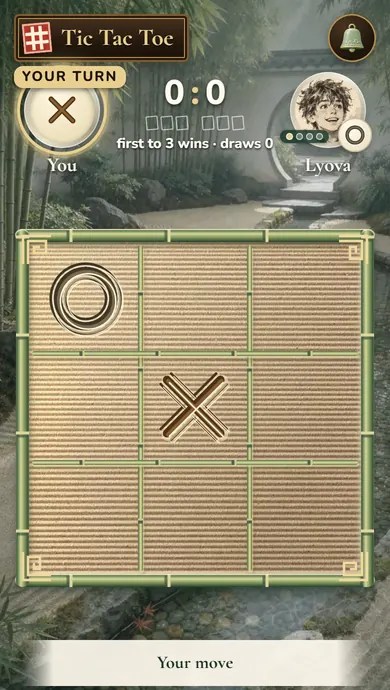
Take the corner 3. Now X on 3 and 5 waits for cell 7 on the diagonal. Lyova plays cell 2 and does not block it.
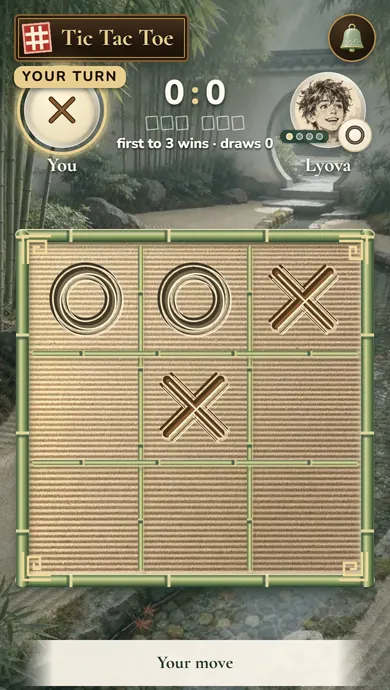
Place X in cell 7: the diagonal 3-5-7 is complete, the line is drawn in the sand and the game is yours.
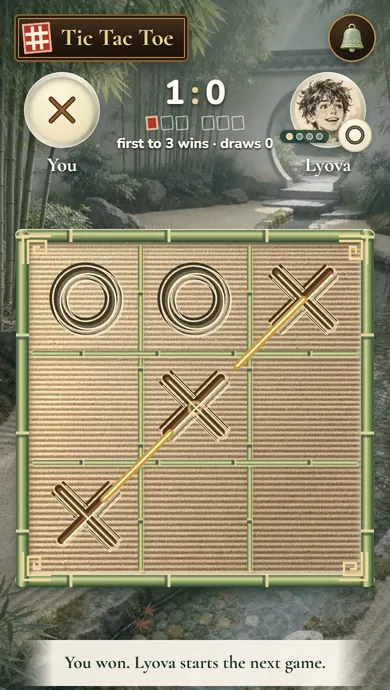
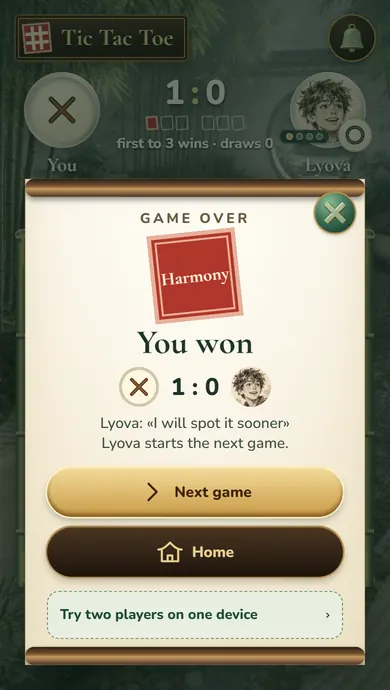
The window says You won, 1 : 0; Lyova starts the next game. Two more wins take the series and its stamp.
A line of two forces an answer. When the opponent misses it, one move wins; against Sever, who never misses, a careful draw is the best result.
No. Against an opponent who makes no mistakes the best result is a draw; Sever, the strongest opponent, never loses the classic game.
The other side: the first move passes from side to side after every game of the series.
After a lost classic game against the computer it shows the decisive move and a better cell, and lets you replay from there.
The game also has three stronger opponents, two players on one device, Vanishing moves and a stamp for every series. This example checks one game against Lyova in the browser build, not every opponent or mode.
Report a changed rule or control The date describes this walkthrough, not a new game release.
Learn the goal, the eight winning lines and when a game is a draw. The guide also explains this game's series and alternating first turns. Open the board when you are ready to try.
Welcome to the classic game of tic-tac-toe! The objective is simple and elegant: be the first player to get three of your marks in a row. This is a game of pure strategy for two opponents, one using the cross mark (X) and the other using the circle mark (O). The first to form a continuous line of their three marks wins the game. This winning line can be horizontal, vertical, or diagonal. There are no points for capturing individual cells; the entire focus is on creating that single, game-winning alignment before your opponent can do the same or the board fills up.
The game is played on a 3x3 grid, which creates a board with nine empty cells. Think of it as a square divided into three rows and three columns. Before a game begins, all nine cells are empty, waiting for the players to make their moves. To make it easier to discuss specific moves and game examples, we will refer to the cells by number, from 1 to 9. The numbering starts at the top-left and moves from left to right across each row.
The top row contains cells 1, 2, and 3.
The middle row contains cells 4, 5, and 6.
The bottom row contains cells 7, 8, and 9.
Using this system, cell 1 is the top-left corner, cell 5 is the exact center of the board, and cell 9 is the bottom-right corner. This simple grid is the entire battlefield where all the strategic action takes place.
Players take turns placing their mark in one of the empty cells on the board. On your turn, you simply select any cell that has not yet been taken by you or your opponent. Once you place your mark, it is final and cannot be moved to another cell. Your turn then ends, and it becomes your opponent's turn to place their mark. The game continues with this alternating pattern of moves. A well-placed mark can serve a dual purpose: it can be a step toward building your own winning line while simultaneously blocking a potential line for your opponent. The game clearly indicates whose turn it is, so you always know when it's your time to make a move.
A game is won the moment a player successfully places three of their marks in a straight line. The game automatically checks for a winning condition after every single move. There are eight possible winning lines on the board: three horizontal rows (cells 1-2-3, 4-5-6, and 7-8-9), three vertical columns (cells 1-4-7, 2-5-8, and 3-6-9), and two diagonals (cells 1-5-9 and 3-5-7). As soon as one of these lines is filled with three Xs or three Os, the game immediately ends, and that player is declared the winner. It is not necessary to fill the entire board to win. A game can be won in as few as five moves.
If the game continues until all nine cells on the board are filled with marks, but neither player has managed to create a line of three, the game ends in a draw. This is also known as a stalemate or a cat's game. A draw is a perfectly normal outcome in tic-tac-toe, especially when both players are making optimal moves. If you find yourself in a series of drawn games against a tough opponent, it's not a sign of a problem; it's a sign that both of you are playing a very strong defensive game. The game recognizes a draw only when the last empty cell is filled and no winning line exists.
A single game ends with a win for one player or a draw. However, you can play a series of games to determine an overall champion. A series continues until one player achieves three wins. The score is tracked for the entire series, showing how many games each player has won. Draws are also counted, but they do not contribute to the three wins needed to win the series. For example, if the score is two wins for you, one win for your opponent, and one draw, the series is not over. You still need one more win. In a series, the right to the first move alternates between players from one game to the next to ensure fairness.
You have two primary modes of play. You can choose to play against a computer opponent, which offers four distinct difficulty levels. The easiest levels are great for learning the game and trying out new strategies, while the highest level provides a significant challenge and will not make any unforced errors. Alternatively, you can play in two-player mode. This mode allows two people to play against each other on the same device. One person makes a move, and then the other person takes their turn on the same screen. It’s a perfect way to challenge a friend or family member sitting right next to you.
Let's look at a quick example of a winning game. Player X starts by taking the top-left cell (1). Player O responds by taking the middle-left cell (4). X then plays in the top-middle (2). O, seeing the threat, should block by playing in the top-right (3), but instead plays in the center (5). On their third move, X places their mark in the top-right cell (3). Now, the entire top row contains X-X-X. Player X has formed a horizontal line and immediately wins the game, even though five cells on the board are still empty.
Now for a draw example: imagine the board is completely full. The Xs are in cells 1, 3, 4, 8, and 9. The Os are in cells 2, 5, 6, and 7. Take a moment to trace all eight possible winning lines. You will see that none of them contain three of the same mark. Since the board is full and there is no winner, this game is a draw.
For a different kind of challenge, you can try the special "Vanishing moves" mode. The rules are the same, but with a twist: each player can only have a maximum of three marks on the board at any one time. When you make your fourth move, your oldest mark is removed from the board right before your new mark is placed. The mark that is about to vanish on your next turn is shown as faded to help you strategize. This changes the game dramatically, as no position is ever permanently secure. A winning line could appear and then disappear in just a few turns! In this mode, a game is declared a draw if 40 moves in total are made without a winner.
Explanation checked 2026-11-17. Studio guide en.tictactoe.rules (docs/page/page-data.json) and spec 01_rules.md, src/game/core/config.js and rules.js (git-house-morn/tictactoe 9a6fb3c), checked against real games in the browser 2026-11-17; the Vanishing moves draw corrected to 40 moves in total