Start here
New to Ludo? Every family starts with its animals in the burrow. Tap the die to roll; a six brings an animal out onto your start cell. Then move your animals around the board and into the nest in the centre.
 NewLudo
 NewWord Burrow
 NewPurr Pieces
 NewTic Tac Toe
 NewHangman
 NewMahjong Connect
 New3D Snake
 NewBubble Shooter
 NewBlock Puzzle
 NewCrossword
 NewWord Search
 New2048
 NewFreeCell
 NewChess
 NewMinesweeper
 NewMahjong
 Dead Moon Relay
 Gridora
 COMET
 Molecular
Ludo rules in one sentence: roll the die, bring your animals out on a six, catch rivals on ordinary cells and race all four into the nest first. Below is a real match from the game, step by step, and then every rule in detail.
Play Ludo →A ManyPlay browser walkthrough · Checked . Screenshots below show the actual game. The catalog image is also a real browser capture. Who publishes these games?
Verified opening-board solution
New to Ludo? Every family starts with its animals in the burrow. Tap the die to roll; a six brings an animal out onto your start cell. Then move your animals around the board and into the nest in the centre.
Here is a real quick game from the start: you play the fox family in the bottom-left corner against the frog, the owl and the bear, all calm computer players. Each family has two animals.
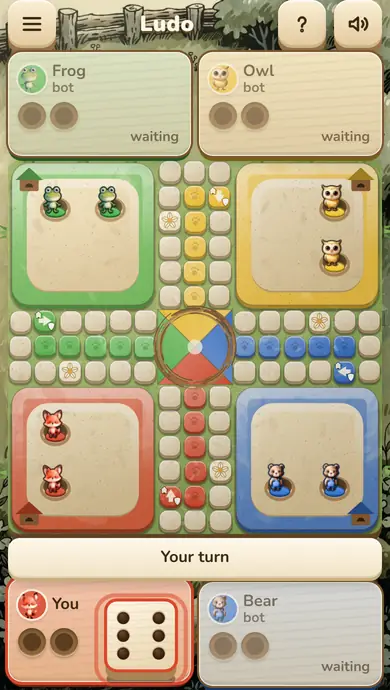
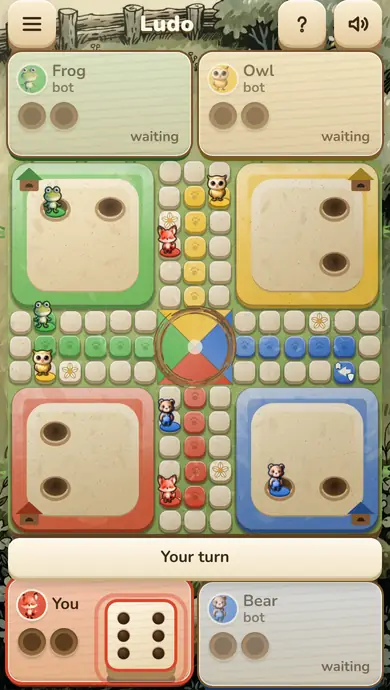
Your first six lets one fox leave the burrow and step onto the red start cell. The six also gives one more roll, so the fox can start its lap at once.
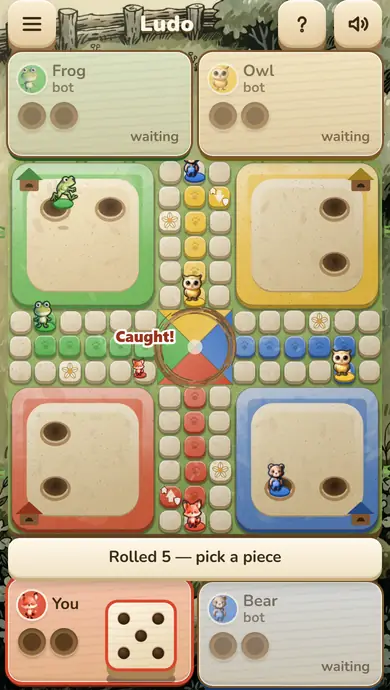
A few turns later the die shows 5, and five cells ahead of your fox stands a frog on an ordinary cell. Tap the fox: it lands on the frog, the game says Caught!, the frog goes back to its burrow, and you roll again.
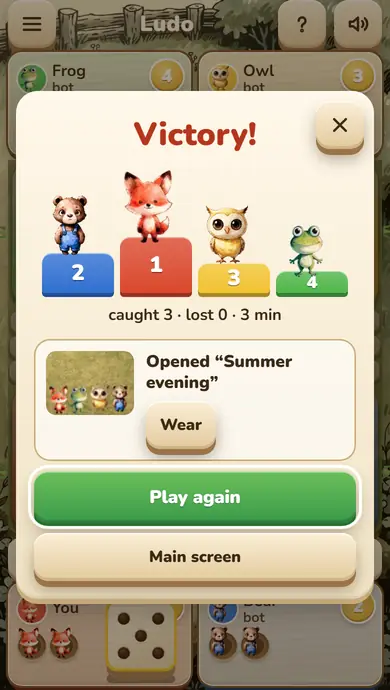
Keep racing, wait on stars when a rival is close behind, and bring both foxes into the nest by exact rolls. The fox family finishes first: Victory!, with three catches, none lost, in about three minutes.
A catch is the biggest swing in Ludo: the rival loses its whole lap and needs a new six, and you get an extra roll. Waiting on stars and start cells keeps your own animals out of reach while the others race.
Yes. An animal leaves its burrow only on a six, and the six gives one more roll.
The rival's animal goes back to its burrow and needs a new six to come out; you roll again. Stars and start cells are safe.
Yes. Only an exact roll takes an animal into the nest; if the roll is too big, move another animal or the turn passes.
The game also has the main match with four animals each, a 2-player match, friends on one device and the bold computer player. This example checks one quick match in the browser build, not every setup or seed.
Report a changed rule or control The date describes this walkthrough, not a new game release.
Ludo is a race board game for two to four players with one die and four animals each. The aim is simple: bring all four of your animals around the board and into the nest before the other families do.
Each player leads a family of four animals around the yard and into the nest in the centre. The first family to bring everyone home wins; the others play on for second, third and fourth place. Turns go clockwise, and you go first.
The board is a cross-shaped track of cells around four coloured corners. Each corner is a family's burrow, where its animals wait at the start. In front of each burrow is the family's coloured start cell. The track runs clockwise around the board, and from each family's last cell a coloured lane of its own leads to the nest in the centre. Stars on the track mark safe cells.
Roll the die. If you have no animal on the track, only a six lets you move: one animal leaves the burrow and steps onto your start cell. If animals are on the track, move one of them forward by the number on the die. The game lights the animals that can move; tap one, or press its number key.
Every animal starts in its burrow. It leaves the burrow and steps onto its family's start cell only when you roll a six. With no animal on the track and no six, the turn simply passes.
A six gives you one more roll. So does catching a rival and bringing an animal into the nest. Use the extra roll to bring another animal out or to run the leader further.
Finish your move exactly on a cell taken by a rival animal and it goes back to its burrow. It needs a new six to come out again, so a catch can turn the whole match around.
Nobody can be caught on a star or on a family's coloured start cell. Animals of different families can share these cells peacefully, so they are the place to wait for a better roll.
Sixes are good, but not too many: a third six in a row burns, and the turn passes on to the next player without a move.
After a full lap an animal turns into its own coloured lane to the nest. Only an exact roll takes it into the nest; if the roll is too big, move another animal or the turn passes.
When a family brings all four home it takes the next free place. The match ends when the order of all players is known.
In a quick game every family has two animals instead of four, so a match takes about five minutes.
Bring a second animal out early: with two on the track a bad roll still gives you a useful move. Park on stars and start cells when rivals are close behind — nobody can catch you there. Count the cells to a rival before you move; a catch also gives you one more roll. Do not rush one animal home alone while the others sit in the burrow. Try a quick game with two animals each when you have about five minutes.
Ludo is played all over the world under many local names, and house rules differ. In some places a token may leave the start on a one as well as a six, or two tokens of one colour on the same cell form a block that others cannot pass. Some tables do not give an extra roll for a catch, or let a player skip the exact finish. This game keeps one clear set of rules - the eight above - and shows them in How to play inside the game.
Explanation checked 2026-11-16. Studio rules docs/page/content/en.json and l10n/en.json rules.* (spec 01, git-house-morn/ludo c72d568), checked against src/game/rules/params.js (presets, bots) and a real quick match in the browser 2026-11-16